Exploring Black British Periodicals at BCA
Black Cultural Archives is an amazing repository of cultural, political and personal histories. Over the last four months, it’s been my privilege to spend time delving into the collections, exploring their depth and breadth. My first visit to BCA’s current home on 1 Windrush Square was rushing to attend the packed opening night back in July 2014. Earlier that evening, I’d run an event at Iniva (The Institute of International Visual Arts) with curator Dr Christine Checinska and sociologist Dr Denise Noble talking about homemaking within Caribbean diasporic communities. Everyone was hugely excited about the opening of the BCA building and how important this would be for making Black histories visible.
During my current placement with BCA, my particular focus has been looking at Black and Global Majority-led magazines, journals and newspapers which cover the arts. As a librarian and PhD researcher, I’m aware of how rare BCA’s extensive holdings are and have delighted in seeing how each periodical tells multiple stories, capturing a moment in time from a particular perspective. Working in the archive, I’ve had the unique opportunity to leaf through old copies of newspapers like The Caribbean Times or the West Indian Gazette, learn about radical anti-racist activism in the pages of journals like The Black Liberator or Race Today and witness the emergence of multiple generations of Black British artists in magazines such as Black Phoenix, Artrage and Polareyes, the first ever magazine by and about British Black women photographers.
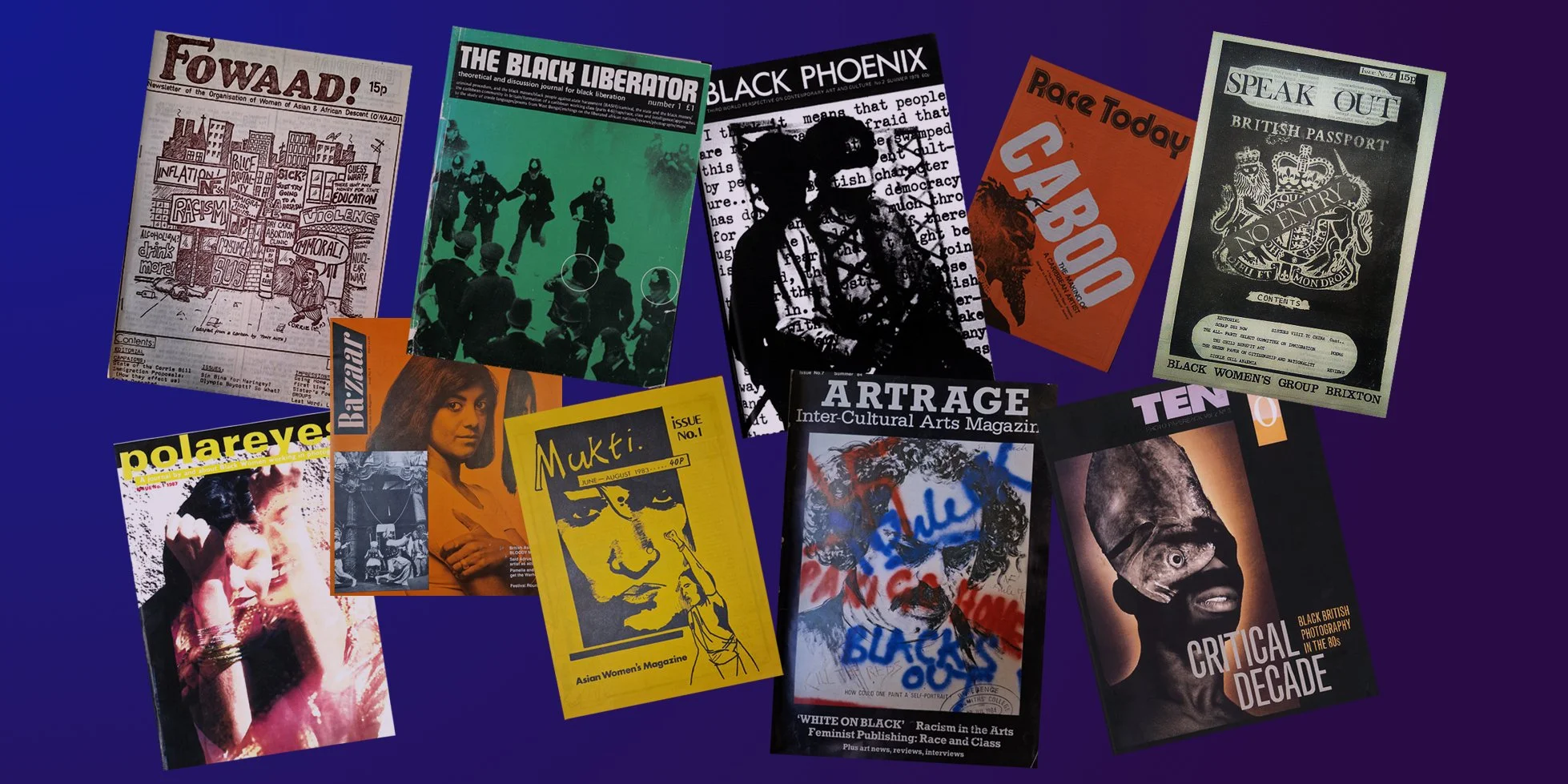
Front covers of various Black & Global Majority-led magazines from our collections
Digging deeper, the collections also shed further light on the lives and stories of remarkable individuals. One object from the archive which provided a glimpse into a whole world of cultural activity was opening an envelop of photographs relating to Richie Riley. Preceding the Windrush Generation, Richard "Richie" Riley travelled to Britain from Jamaica in the late 1930s and achieved fame as the co-founder and principal dancer of Les Ballets Nègres, Europe’s first Black dance company. After the company disbanded in the 1950s, Riley turned to visual arts and in later life was among those who helped to found BCA. While rarely openly discussed, his queer sexuality also shows how intersectional histories exist in the archive. He exhibited his paintings and sculpture throughout the last decades of his life, but no solo catalogues of his work were published and only one group catalogue includes an illustration of his work. Without the photographs held at BCA, there would be almost no visual record of his artwork. These images give a unique insight into the creative development of a queer Black British artist in the middle of the twentieth century, which would otherwise be lost to history.

Artwork titles and photographer unknown
To explore the Periodicals collection further, a great place to start is the Periodicals Subject guide or search the catalogue for individual titles https://collections.blackculturalarchives.org/repositories/2/resources/38
In partnership with the University of the Arts London, Black Cultural Archives recently delivered a public study day bringing together people interested in exploring arts and activist magazines from the collection. A recording will soon be made available via the BCA’s YouTube channel.
By Nicholas Brown, PhD candidate at UAL
Nicholas Brown is a librarian and PhD candidate at the University of the Arts London, researching Black British artists and print culture, with particular attention to independent magazine publishing. His research examines how magazines produced by and about Black artists and writers in the 20th century functioned as key sites of contestation, fostering new positions and understandings of how visual arts intersect with issues of race, class, gender, sexuality and the legacies of colonialism. He has formerly managed several university, gallery and cultural institution libraries, most importantly The Stuart Hall Library at Iniva (the Institute for International Visual Art). Over the last four months, he has undertaken a placement at Black Cultural Archives. A recent article is available here - Publishing as insurgency: Black and South Asian women artists transforming feminist magazines (Journal of Gender Studies, 2025)
This piece was developed with curation support from Harlynn Homan, Archives Manager